Methanation pilots on the platform
DENOBIO demonstrator
ENOSIS (SME created in 2014) and INSA Toulouse have been working closely together since 2015 to develop an innovative biological methanation technology using mixed cultures.
The DENOBIO project marks a new stage in that collaboration.
Started in 2024, it includes the implementation of an industrial demonstrator, integrated into a methanation site producing biomethane (Energia Thiérache, in Lesquielles-Saint-Germain, in the Aisne department).
This should allow DENOBIO to confirm the technical and economic performance of the biomethanation process on an industrial scale, and to certify the renewable nature of the gas produced.
Two test phases are planned:
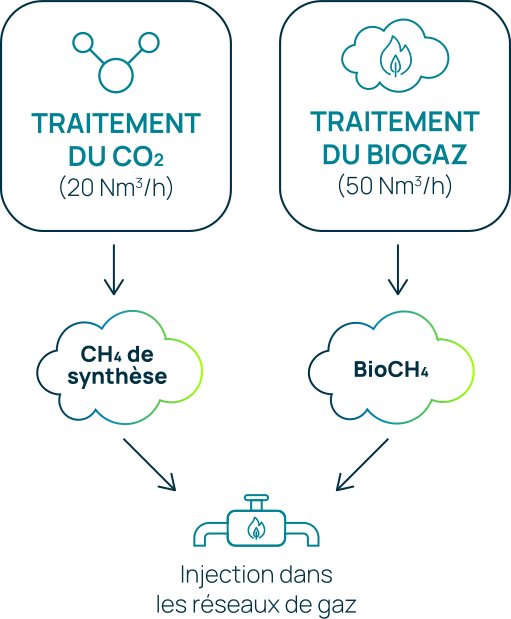
the first will consist in processing the CO2 (20 Nm3/h) discharged from the methanisation site’s purification system, and the second will process the biogas directly (50 Nm3/h).
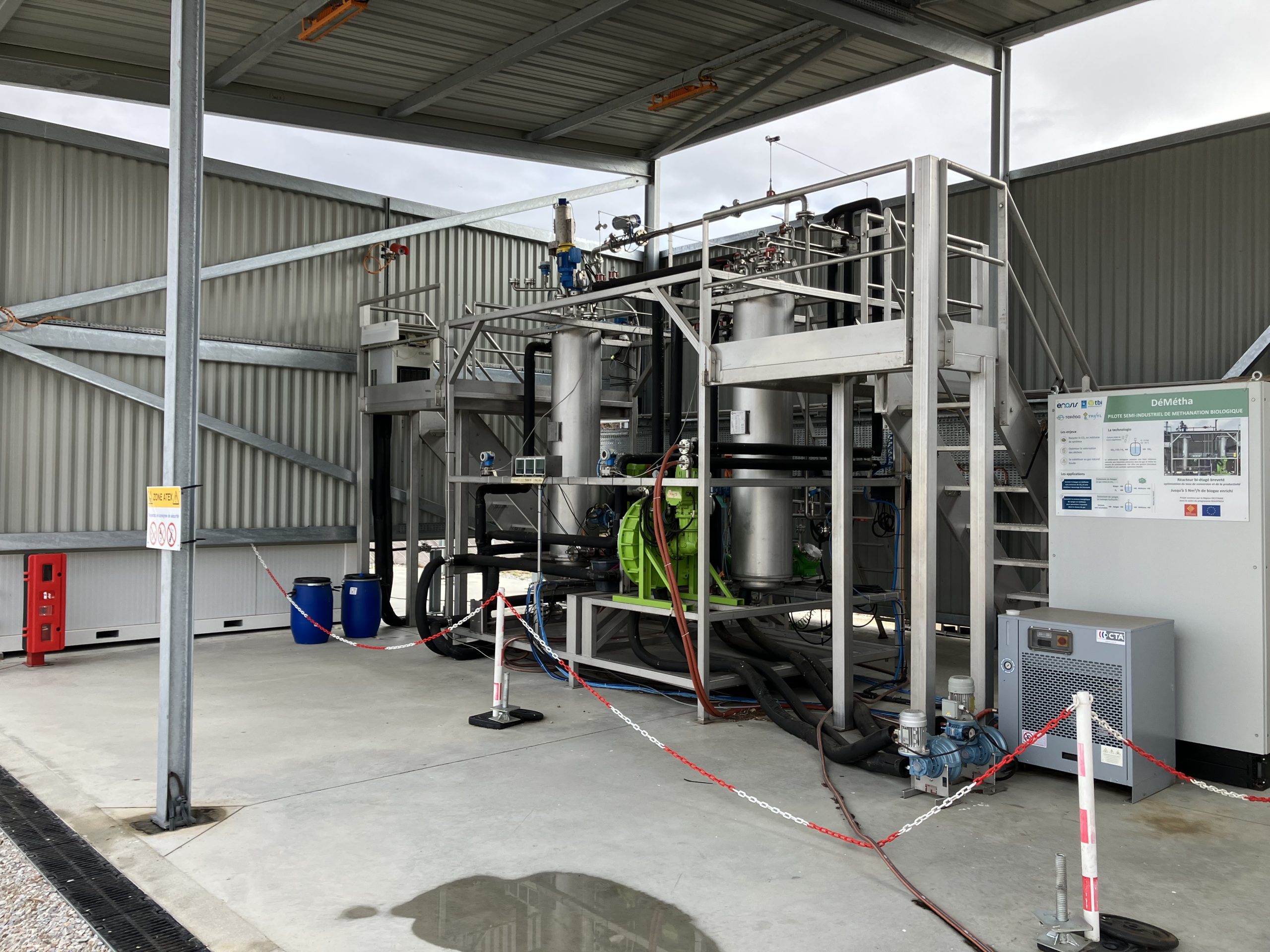
Here, DENOBIO is mobilising the expertise of CRITT GPTE and the resources of the SOLIDIA Biogaz platform, with its DEMETHA semi-industrial intermediate-sized pilot plan, to confirm ways in which the process can be optimised and to enhance control strategies.
DENOBIO receives assistance from ADEME via the “hydrogen demonstrator and technological building blocks” scheme, part of the France 2030 investment plan.
At the end of this work, provisionally scheduled to take 18 months, the biological methanation technology developed by Enosis and INSA Toulouse should have reached commercial maturity, meaning level 9 on the TRL scale, in the case of the processing of CO2 contained in the biogas from methanisation.
In these industrial tests, DENOBIO combines the scientific activities undertaken by INSA Toulouse’s TBI laboratory. These are the multiphysical modelling of the process and the analysis of the system’s energy efficiency.